'I will not be surprised if there is a 7 per cent handle in front of the decimal place for the full financial year.'
The era where nations thrived through rigid alignments is giving way to an age where the connective State defines power. For India, that era has arrived, points out Dr Nishakant Ojha.

The defence minister also announced that India has taken up the challenge of developing a powerful indigenous aero-engine, adding that preparations for this critical project are now almost complete and the work will soon be visible.
'In the Indian government there are no illusions about the United States reliability or the possibility of having any kind of preferential treatment from Washington when it comes to trade.'

The stock and bond markets told Trump firmly that any idea of isolating China would lead to harming the US economy and this forced Trump to backtrack, points out Aakar Patel.
The trade relationship between India and the United States has been strained by the imposition of 25% tariff by the US on Indian goods.

'A man who brought about the greatest set of economic reforms in the country, who changed the course of Indian history, cannot be considered weak.' 'A man who fought for nuclear reforms even though his majority in Parliament was threatened, he cannot be considered weak.'
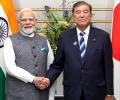
Prime Minister Shigeru Ishiba's sudden resignation after only a year in office has thrown Japan into political turmoil, raising doubts about how the country will handle economic and regional challenges, observes Dr Rajaram Panda.

'India is a rising power and it'll become one day a great power. I think the diplomatic skills, the execution of a flawless G-20 sends the message that India has arrived on the scene and it is becoming a great power'

Trump couldn't care less anymore about the Israeli demand for Iran's 'de-nuclearisation' and 'de-militarisation.' Trump pins hopes on a grand bargain with Iran as a partner in America First, argues Ambassador M K Bhadrakumar.

No longer Bengal's finance minister, Amit Mitra, Mamata's principal chief advisor, will still advise and aid the 'chief minister and finance department on all matters relating to management of state finance', represent the 'state government in national and international events/meetings/committees' and examine 'important proposals/files and policy issues relating to financial matters referred to him for advice/views'.
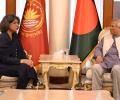
Bangladesh has demanded a public apology and compensation from Pakistan for the 1971 atrocities, raising "historically unresolved issues" during the first foreign secretary-level talks between the two countries in 15 years. Dhaka also asked Islamabad to pay USD 4.3 billion as its share from the combined assets at the time of East Pakistan's split from West Pakistan in 1971 to form an independent Bangladesh.
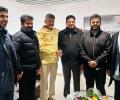
Barring a few, such as Andhra Pradesh Chief Minister N Chandrababu Naidu (74), Union Minister C R Patil (69) and Uttar Pradesh Finance Minister Suresh Khanna (71), most other ministers attending the WEF represent the next generation of India's politicians.

'Not paying workers enough will end up being self-destructive or harmful for the corporate sector itself.'

The annual Edelman Trust Barometer report, released every year during the World Economic Forum's Davos summit, also showed that business has replaced government as the most trusted and is now followed by government and media in that order.

Union Finance Minister Arun Jaitley said despite a global slowdown and its impact on countries, India remains insulated from the economic fallout.
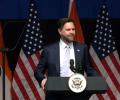
US Vice President JD Vance called on India to drop non-tariff barriers, give greater access to its markets and buy more American energy products and military hardware. Vance, in a speech in Jaipur, highlighted the need for a stronger US-India partnership for a prosperous and peaceful 21st century. He emphasized the importance of working together to address global challenges and praised Prime Minister Narendra Modi, describing him as a "special person." Vance also urged India to provide greater market access to American products and buy more defense platforms and energy from the US. He suggested that India consider dropping some of the non-tariff barriers for American access to the Indian market and highlighted the benefits of closer India-US defense collaboration, advocating for New Delhi to procure more military hardware from the US. He cited the example of American fifth-generation F-35s, arguing they would give the Indian Air Force the ability to defend its airspace and protect its people like never before. Vance also welcomed the Modi government's budget announcement to amend India's civil nuclear liability laws, paving the way for US producers to export small modular reactors and build larger US-designed reactors in India. He emphasized the importance of energy security for India's AI ambitions, stating "there is no AI future without energy security and energy dominance." Vance's visit comes amid growing global concerns over the US's tariff war.
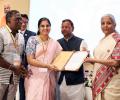
'Tax rate and stock markets are entirely two different things.'
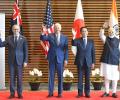
Biden welcomed Prime Minister Modi at the Summit and said "it is wonderful to see you again in person".
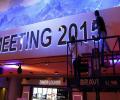
The World Economic Forum's five-day annual summit began in Davos this evening amid hopes of recovery in global economy and a time of renewed terror threats after recent strikes in France and other parts of globe.

West Bengal Chief Minister Mamata Banerjee has left no stone unturned this year after big industrialists, along with Union ministers, skipped attending the BGBS 2017.

PM Modi went to New York this time not to engage in polemics, but to find solutions to global problems. He made some progress on several matters, even on reform of the UN Security Council, when the US made a major concession for the first time that six permanent members without veto, including India, could be considered

'Every Indian should move to an EV, and the government should not buy any fossil fuel cars. The government should become the first driver of EV adoption.'
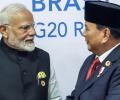
India is trying hard to erase Indonesia's wariness about New Delhi, building security cooperation in the Indian Ocean and Pacific Ocean. If Indonesia decides to buy the Brahmos missile, it would further strengthen relations between the world's most populous nation and the most populous Islamic country.
Days after the fraud allegedly masterminded by diamantaire Nirav Modi came to light, the prime minister asked the management of financial institutions as well as the supervisory bodies to do their job diligently to check such frauds.

Railways can contribute 2.5 per cent to three per cent in the GDP with an improved infrastructure, he said.

The Indian startup ecosystem has lauded the inclusion of startups in the New Delhi Leaders' Declaration for the first time ever in the history of G20. Industry stakeholders say that the move will lead to easier access to capital, reduce regulatory hurdles, and may revive funding activity. The Declaration, through the Startup20 initiative, recognised startups as "natural engines of growth" and key to socio-economic transformation by driving innovation and creating employment.
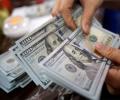
In response to the panic triggered by Trump's trade policies, the RBI net sold approximately $43 billion in the second half of FY25 to curb volatility, as the rupee plunged to a low of 87.95 per dollar in February this year.
American inventor's thoughts about India is not being well received.

'We will likely never know why Xi decided not to travel to New Delhi. One possible explanation could be his desire to avoid a meeting with US President Joe Biden.'

The Kerala unit of the Congress instantly gets a headache when Shashi Tharoor lets loose one of his observations showering flowers on enemy territory. With every such action triggering controversy within a nervous Congress party, some feel it is high time Tharoor showed a degree of solidarity with the ideals of his party, notes Shyam G Menon.

Prime Minister Narendra Modi Wednesday said the International Monetary Fund (IMF) sees India as a "bright spot" in the global economy and as per the World Bank, India is in a better position to deal with the global headwinds than many other countries. This is because of India's strong "macroeconomic fundamentals", Modi said while virtually addressing the inaugural function of the 7th edition of Invest Madhya Pradesh-Global Investors Summit in Indore. In the past eight years, the government has increased the speed of reforms and removed many hurdles in the way of investments.

China, the Ukraine crisis and Quad will dominate the discussions, observes Dr Rajaram Panda.

Keshav Joshi's tongue in cheek look at Narendra Modi's mega plans.

Opportunity for India to take leadership in economic diplomacy.
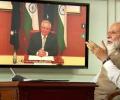
The Mutual Logistics Support Agreement will allow militaries of the two countries to use each other's bases for repair and replenishment of supplies besides facilitating scaling up of overall defence cooperation.
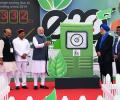
'We are not asking for incentives, but at least taxation can be aligned such that the rupee tax on consumers remains the same.'
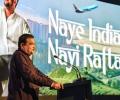
From highways connecting once-remote regions to aviation networks carrying millions, India's infrastructure story is one of transformation.

Citing India's commitment to deep economic reforms and ease of doing business, Prime Minister Narendra Modi asserted on Monday that this is the best time to invest in the country as policy-making is focussed on the needs for the next 25 years for a 'clean and green' as well as 'sustainable and reliable' growth period. In his special address to the World Economic Forum's online Davos Agenda 2022 summit, Modi underlined a host of reform measures undertaken by his government to stress that it has worked to reduce the administration's interference in business by deregulating many sectors and to clear the way for free trade agreements with different countries. India was once associated with "license raaj", he noted and highlighted the measures, including reduction of corporate tax to boost business and doing away with over 25,000 compliance requirements.
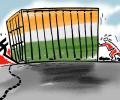
India has been relatively insulated from the severe headwinds in the West. However, with a third of the global economy expected to slip into recession in calendar year 2023, the impact will strongly be felt on India's exports and trade economy, leading economists said in a panel discussion at the Business Standard BFSI Insight Summit in Mumbai on Wednesday. The panel comprised former Reserve Bank of India executive director and former Monetary Policy Committee member Mridul Saggar, State Bank of India Chief Economic Advisor Soumya Kanti Ghosh, Citibank India Chief Economist Samiran Chakraborty, ICRA Chief Economist Aditi Nayar, and IndusInd Bank Chief Economist Gaurav Kapoor. The topic of the panel discussion was No recession in sight: Is India decoupled from developed economies?
